

In Summary
Welcome to our page about the wellbeing of almost 10,000 young people who took part in the My Health, Our Future in 2025. Discover what they told us in our summary below, or download our report for more detail and analysis.
Read a summary of key findings
Our findings continue to show how young people’s wellbeing varies across different groups and is shaped by many factors affecting their lives.
Average wellbeing
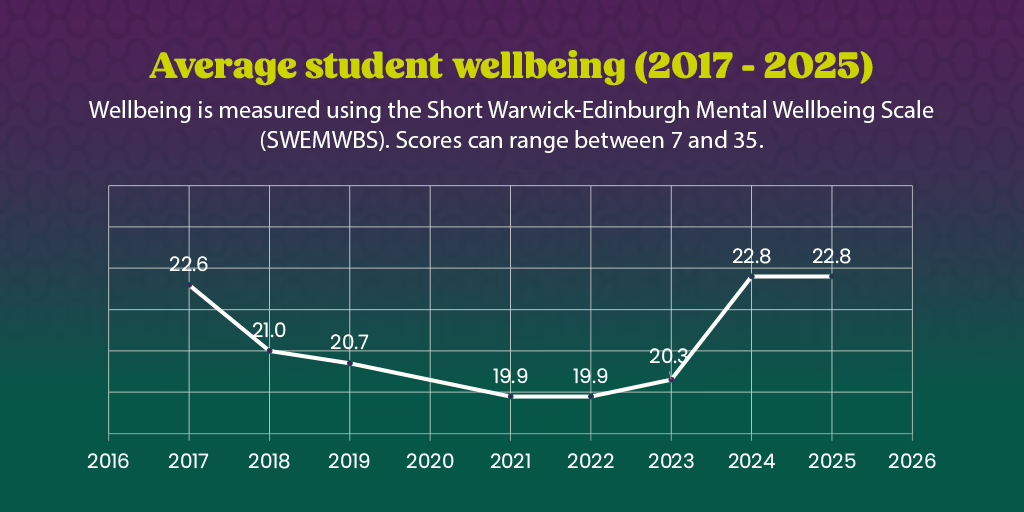
The graphic below shows how the average wellbeing of young people remains the same as we recorded in 2024, stabilising just above a level previously recorded in 2017.
A few highlights from the report
The survey asks about an array of topics, including anxiety, feelings of safety, sleep, social media, future careers and many more.
- On average, young people in Suffolk had lower levels of happiness and higher levels of anxiety than young people aged 16 to 24 across the UK.
- 16% of students (1,579) felt close to others ‘rarely’ or ‘none of the time’.
- Half of students reported ‘very high’ or ‘high’ levels of happiness.
- Just over half of students failed to get their recommended levels of sleep, and levels of sleep may be at the lowest we’ve recorded in our surveys. Students who get more sleep have higher average wellbeing scores, and 44% felt lack of sleep was affecting their concentration at school or college.
- Most (88%) students felt they had control over shaping their future to some extent.
- Almost half of students agreed climate change would significantly impact their future.
- Just over a quarter (26%/ 1,359) of young people wanted to pursue a career in the NHS.
- Of those using nicotine (1 in 10), almost half said they used it to control their emotions (e.g., stress, anxiety, anger).
Sexual harassment and violence
Our survey included a definition of sexual harassment:
“Sexual harassment is any unwanted sexual behaviour that makes someone feel upset, scared, offended or humiliated, or is meant to make them feel that way.”
Within this context, young people responded to a series of statements about some forms of harassment they may have seen in school or college, ranging from people ‘making sexual jokes’, to ‘sexual threats’ and ‘unwanted sexual behaviour’. And, reflecting national concern from Ofsted, thousands said they had seen at least one form of potential sexual harassment at their school or college.
A few of the key findings included:
- More than two out of every five students indicated they had seen or heard at least one form of potential sexual harassment or violence in their school or college.
- A quarter of young people had seen or heard the sharing of sexual images or videos of another student.
- Almost 1,000 students reported having seen or heard of unwanted sexual touching (18%).
- Students who identified their gender another way (67%) were most likely to report witnessing sexual harassment, followed by female students (51%), and then male students (32%).
Consistent with findings in 2024, students in Years 9 to 11 were more likely to report sexual harassment and violence within their school, compared to older students in Year 12 and above. While the exact reasons for this are unclear, several factors may contribute. Older students may become more desensitised to such behaviours over time, spend less time in group settings due to the structure of post-16 education, and are more likely to encounter these issues outside of school as they gain greater independence.
When asked about what would help young people to report sexual harassment, the top responses were knowing what happen (44%) and knowing they would be taken seriously (42%).
Bullying and harassment
Rates of bullying remain a prominent and potentially increasing concern for many young people. Students reporting concern about bullying consistently report lower wellbeing scores than those who do not.
In 2018, 15% of students indicated they had been bullied in their community. This compares to 31% of students who said they felt ‘unsafe’ in the community because of bullying in 2024/25 – a figure that increases to 41% of students with any number of additional support needs identified in the survey (e.g., being a family carer, or living with a disability).
Students this year identified bullying (31%) as the leading cause for feeling unsafe in their local community, followed by knife crime (22%) and gang activity (21%). However, among students who described their gender another way, 70% identified homophobia or transphobia as their primary concern.
Social media
US law restricts companies from collecting data on users under 13 without parental consent and this is reinforced in the UK by the General Data Protection Regulation (GDPR).
Despite this, 724 students in Year 7 said they were using it for more than four hours on a typical school or college night. A further 827 students in Year 8 indicated this. Most students are not 13 until they are in Year 9.
Our data indicates young people are using social media more now than they were six years ago. On a typical school or college night, 38% were using it for four hours or more in 2017/18. This has increased to 46% of students in 2024/25.
The impact of increased social media use is evident within our data. For example, we can see that levels of wellbeing and sleep both decline with increased social media usage. The degree to which this is the case varies across student groups. The same is true of time spent on social media, with some groups of students (e.g., those with additional support needs) indicating increased likelihood of spending four hours or more on social media compared to their peers.
Could we support your next project? Please contact our team.
Please note, we use a third party service called Typeform to manage this form.