

In Summary
Welcome to our page about the physical and mental wellbeing of the more than 9,000 young people who took part in our My Health, Our Future (MHoF) survey in 2024.
Summary of key findings
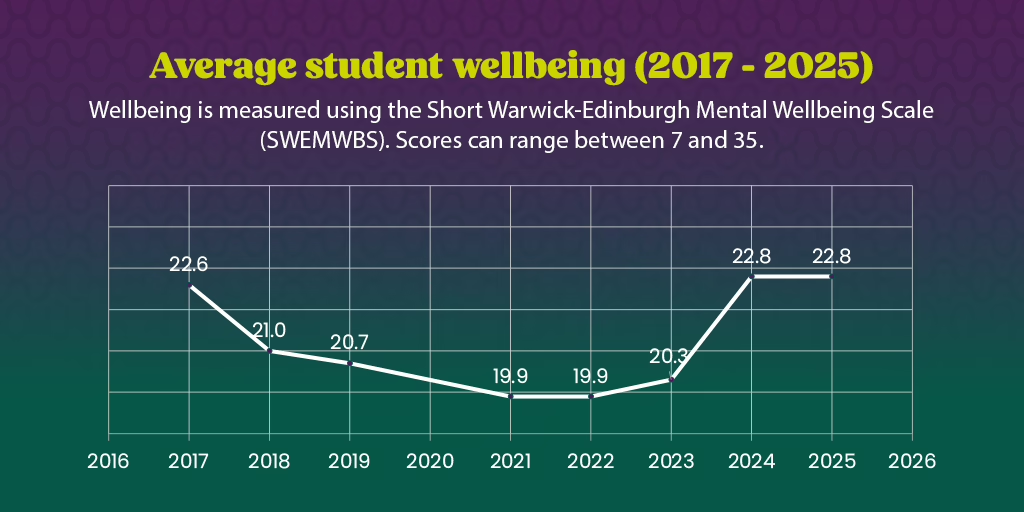
Our latest data showed young people’s wellbeing continued to improve this year, reaching higher levels than previously recorded in the My Health, Our Future (MHoF) programme.
This is good news for young people overall, but we warned that this positive conclusion should not mask the inequality of how some young people were more likely to experience problems with their wellbeing. Average ‘wellbeing scores’ remained below a level recorded by the NHS in 2020.
The graph below (updated in 2026) showed how young people’s average wellbeing scores changed since 2017. Wellbeing is measured using a widely-used measure known as the Short Warwick-Edinburgh Mental Wellbeing Scale (SWEMWBS). Students can receive a score between seven (lowest possible wellbeing) and 35 (highest possible wellbeing).
The average in 2024 was 22.8.
More than 9,000 young people took part in the survey in 2024.
They responded to questions about many different things affecting their lives, including about witnessing sexual harassment, sleep, feelings of safety at school or college, body image and their eating habits.
Some key findings included:
- 2,034 young people (35%) said they had seen at least one form of potential sexual harassment at their school or college, compared to 57% in 2023. This included students who had seen or heard ‘the sharing of images or videos of other students of a sexual nature’ (1,022), ‘sexual threats’ (567) and ‘other unwanted sexual behaviours’ (571).
- Those who reported having seen or heard sexual harassment at school or college were likelier to feel unsafe, especially in hallways and toilets. Less than a third of those who reported having seen or heard potential sexual harassment reported feeling safe in all school or college areas, compared to almost three-quarters of those who had not.
- 1,584 (20%) had felt unsafe at school because of bullying or cyberbullying. Hundreds of other students felt unsafe because of discrimination and/or harassment.
- 45% had worried about how they looked ‘nearly every day’ or ‘more than half the days’ in the month before taking the survey. Female students and LGBT*Q+ students were amongst the most likely to worry about this.
- 30% (2,473) were worried about their eating habits.
- Students who reported lower than recommended daily sleep had lower average wellbeing scores and noted impacts on their mood and concentration.
- A quarter of young people were not getting the recommended daily levels of exercise. Students who exercised more often said they got more sleep, reported higher wellbeing, and were happier about their appearance and health.
- High numbers of young people (73%) said a friend had talked to them about their mental health, including things like anxiety, depression, and feeling low.
What could help young people to feel happier?
Commenting about the findings, Wendy Herber (Independent Chair, Knowing Works) said:
“Year after year, we have welcomed the extensive support of the NHS, local schools and colleges and many other organisations to explore young people’s wellbeing through this programme. This research, and its extraordinary response rate each year, is a critical source of evidence and insight upon which those responsible for planning support for young people can base their decision-making.
“As in all years of the MHoF programme, we continue to observe inequalities in our data between different groups of young people, including young people who did not identify with binary gender categories, LGBT*Q+ young people, and those who had additional support needs. Furthermore, we continue to highlight the alarming prevalence of young people who reported having seen, heard or experienced forms of harassment, bullying or abuse in school or college.
“With overall wellbeing showing a marked improvement this year, our findings indicate a positive wellbeing trajectory for many young people in Suffolk. However, they must also remain a collective call to action to leaders across sectors to remain focused on wellbeing support for all young people and to confront and eliminate all of the forms of abuse they experience.”
Beyond tackling the impacts of abuse or harassment, our findings show how following essential advice regarding teenage sleep and exercise can be a simple but effective way to improve young people’s wellbeing overall.
This year’s findings also demonstrated the importance of equipping young people to help each other. We know young people are much more likely to talk to friends about their mental health than any adults in their lives, but they are not always well-equipped to offer the help their friends may need. This is particularly true of younger students (a quarter of Year 7 students said they would not know where to access support if they were worried about a friend’s mental health).
Our survey included questions about things that could help young people to feel happier at school or college and about their future. Answer options in the questions were co-produced with young people and professionals before the survey was launched. The questions were important because, in the 2023 survey, only a third of young people felt optimistic about their future and findings indicated higher than national average unhappiness with school.
Our findings suggested that young people value opportunities for quiet reflection at school or college. This may include having dedicated quiet spaces in school or small gaps between lessons. Students felt practical support around managing homework and workload, building confidence and self-worth, managing money and obtaining life skills would also support them to feel better about their school and future. Many others would welcome more information about volunteering, work experience opportunities, colleges, universities and career options.
Understand the impact of MHoF
The NHS commissions the survey in Suffolk to shape and inform decision-making about support for young people across organisations and sectors.
In addition to the countywide survey results, every school or college supporting the survey receives an anonymous report about their students. It helps them to plan, target and construct wellbeing support and strategies.
We share more information about how the programme has made a difference at https://knowingworks.co.uk/case-studies/mhof/mhof-impact.