In Summary
Welcome to our page about the wellbeing of nearly 12,000 young people who took part in the My Health, Our Future survey in 2019. Discover what they told us in our summary below, or download our report for more detail and analysis.
The challenges and complexity of children and young people’s mental health were revealed in our 2019 report. This was the third report in our now extensive series of insights.
In this year, almost 12,000 young people took part in a lesson plan and survey across sixteen schools and colleges.
Our data showed that young people were facing increasing challenges to their mental health and that their subjective wellbeing was lower than a national average (a finding that has persisted across the programme since).
We explored a range of factors that were causing young people to worry about their wellbeing and focused on issues such as self-esteem, body image, self-harm, bullying, mental health education and young people’s experiences of finding help.
Read some key findings
“I don’t want to be a burden to anyone and I feel I’m not good enough for people’s time and breath.”
Despite increasing concern about their wellbeing, our report reveals more than half of young people did not ask anyone for help when they needed it. Of those who did ask for help, the majority indicated they had approached close friends or family.
There were a number of reasons why young people may not have been finding help. Students who had turned to mental health services often found them difficult to access or were passed between them. Others said they would feel embarrassed or worried about being a burden on the those around them.
The most common reason for not seeking support was that they did not want help or felt they should deal with problems on their own.
Other findings included:
“People are horrible to me, saying they’re going to beat me up and I should kill myself.”
- 45% indicated they had experienced poor mental health in the last year.
- 55% who experienced poor mental health had not sought help. Male students were less likely to have sought help than female students.
- 14% said they had previously self-harmed and 14% did not say.
- Young people in Suffolk had a self-esteem score that was more than four points lower than a national average for the scale we used.
- 22% of male students and 58% of female students worried about their body image most or all of the time.
- 15% of male students and 18% of female students had seen content online that showed self-harm or suicidal behaviour. Those who had seen this content were one and a half times more likely to say they had self-harmed.
- 14% of students aged over 14 had used cannabis in the last year and 3% said they had used cocaine. Male students were more likely to have used drugs.
- Young people’s wellbeing declined with increased use of social media. However, those young people who had not used it at all had poorer wellbeing than those who were low level users.
For the first time, the report explored differences between specific groups of young people (e.g. young carers and students from diverse backgrounds).
- Young people belonging to an ethnic minority were less likely to say they would approach their parents for help.
- 61% of young people with a disability had experienced poor mental health within the last 12 months.
- Children in care were twice as likely to say that they had self-harmed (1 in 3 children in care had self-harmed and 14% said they currently self-harmed).
- Young carers were almost twice as likely to say they had been bullied online.
Expression through creativity
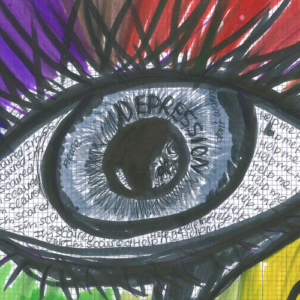
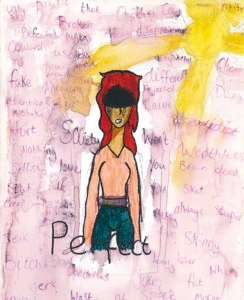
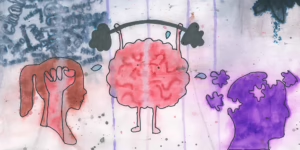
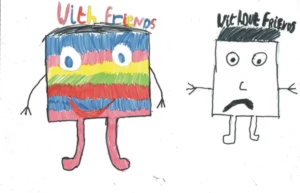
In addition to asking them to respond to questions, our programme also invited young people to express themselves (in MHoF phase two and three) by sharing interpretations of mental health and wellbeing in the form of artwork completed in school. They also recorded impactful and emotive comments about their experiences of mental health, body image, cyberbullying and low self-esteem.
A few examples are shown below, but you can find more in our full reports.