

In Summary
Welcome to our page about the wellbeing of more than 4,500 young people who took part in the My Health, Our Future survey in 2021. Discover what they told us in our summary below, or download our report for more detail and analysis.
Read a summary of key findings
In total, we heard from more than 4,500 students in 2021.
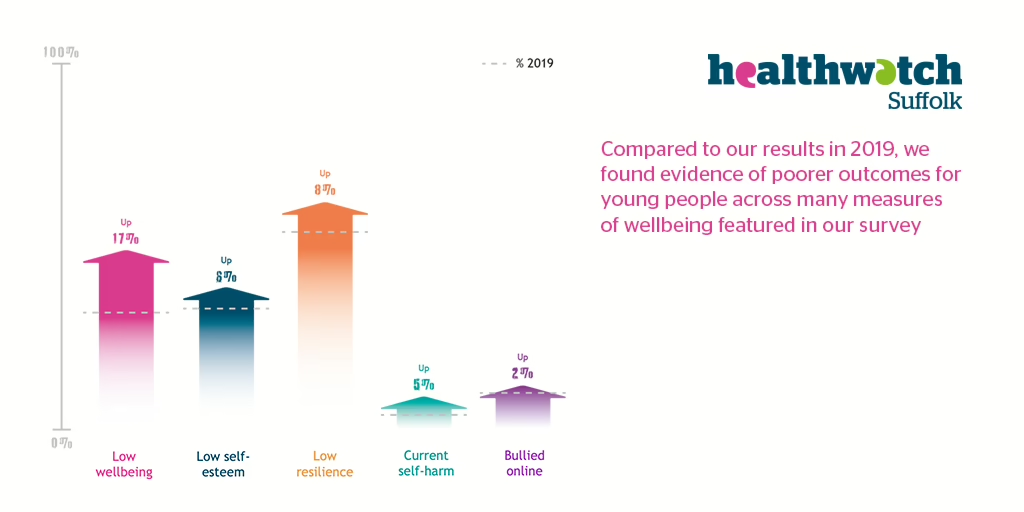
In 2021 (phase five), amongst many other insights, we found higher incidence of low wellbeing, self-harm, low self-esteem and reports of online bullying.
Five key findings
- Our data continues to indicate inequality, with some groups (e.g., young people from multi-ethnic communities, students with disabilities and LGBT*Q+ young people) disproportionately impacted by mental health and emotional wellbeing concerns.
- Average wellbeing scores have fallen since our last survey in 2019.
- Between 2019 and 2021, young people’s average resilience has dropped into a ‘low resilience’ classification. Students who described their gender in their own way were the least resilient group.
- Eighty-six percent said their school or college gave them information about mental health, but 43% felt it did not cover things they wanted to learn about.
- Rates of reported ‘current’ self-harm have increased since 2019. Nine percent of young people said they currently self-harm and 16% said they would prefer not to say. Of 339 students who said they ‘currently’ self-harm, 175 identified as LGBT*Q+.
Commenting on the report in 2021, Jaime Hawkins (Transformation Lead for Children and Young People’s Mental Health, NHS West Suffolk, Ipswich and East Suffolk and North East Essex Clinical Commissioning Groups) said:
“Our children, young people and families have shown incredible resilience and strength during the pandemic. However, as this survey shows, many families have been significantly impacted and demand for emotional wellbeing and mental health support has grown exponentially. We have seen an incredible response from our schools, providers and the VCS to support growth in demand and continue to hold families whilst services can stabilise and adapt.
“It is clear from the survey that there are some children and young people who are not getting the support that they need, and as a system we need to listen and respond. We continue to learn from our children, young people and families so that we can develop and provide services where all can thrive, wherever they live in Suffolk.”
Impact of the pandemic
Our data indicated the pandemic, and associated lockdowns, may have had a lasting and detrimental impact on young people’s perception of their mental health.
By referring to definitions we provided, students were able to indicate whether they were ‘Healthy’, ‘Coping’, ‘Struggling’ or ‘Emotionally Unwell’ at different stages of the pandemic. Most students completed the survey from May to June 2021, following a further lockdown and move to tiered restrictions in December 2020.
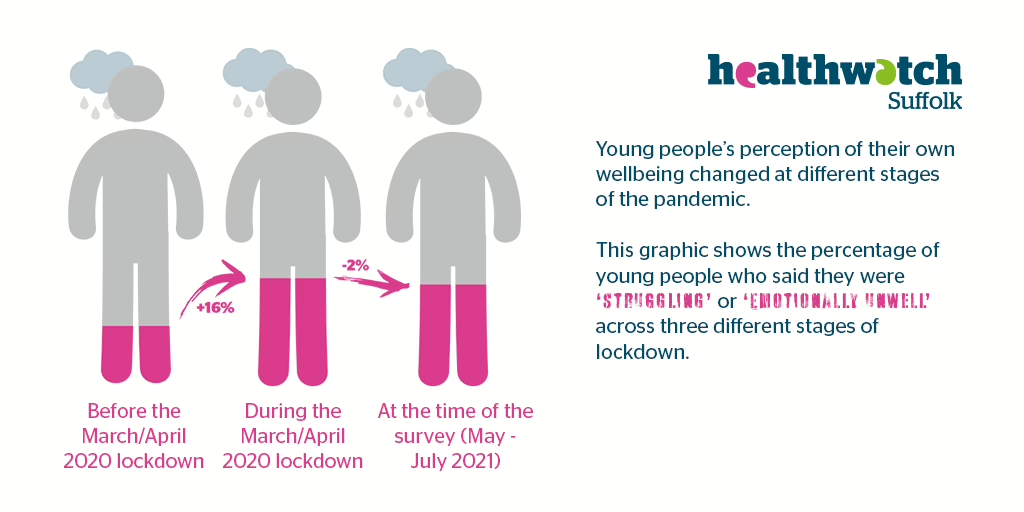
Female students (38%) were more likely to report that they were ‘struggling’ or ‘emotionally unwell’ than male students (27%). Those who preferred to describe their gender in another way were much more likely to report that they were struggling (59%).
Other findings in 2021
Here are just a few that stood out:
- LGBT*Q+ students tended to experience poorer wellbeing than their peers. They were also more likely to report self-harm, lower self-esteem, and poor outcomes against many other measures.
- One in five students indicated they had felt loved rarely or none of the time.
- Self-esteem scores have reduced from 16.7 in 2019 to 16.1. This puts young people in Suffolk at the very bottom of the ‘normal’ range. The number of students reporting low self-esteem increased with school year. Students who chose to describe their gender in their own way reported the lowest self-esteem overall (more than 80% of their scores indicated low self-esteem).
- Forty-seven percent of young people indicated they may have experienced poor mental health in the 12 months previous to their completion of the survey.
- Thirty percent of children and young people receiving free school meals reported that they had experienced a mental health difficulty but not sought support. They were amongst the most likely to indicate this.
- Twenty-seven percent of male students indicated they ‘just dealt with it themselves’ when they had poor mental health. They were more likely to indicate this than other groups of students.
- Eighteen percent (673) said they had been bullied in school and 10% (395) indicated that they had been bullied online. Forty-one percent of young people who had been bullied said their school or college was not aware of it, and 28% preferred not to say.
- As with many measures, there were clear gender differences related to rates of current self-harm. Young people who preferred to describe their gender in another way were much more likely to be vulnerable to self-harm, than either male or female students.
Please download our report for more detailed findings and analysis.