

In Summary
Insights from My Health, Our Future (MHoF) are used annually by people, professionals, and organisations working to support young people across sectors. From shaping strategies, to attracting funding to Suffolk, read on to explore some of the ways people tell us they are making a difference with MHoF data.
My Health, Our Future (MHoF) is Suffolk’s biggest annual survey of young people’s physical and mental wellbeing.
Our programme offers an unparalleled data set on the wellbeing of children and young people across Suffolk. As an important source of evidence, the data has helped many leaders and decision-makers to shape local support.
“The annual MHOF survey has been a great source of insight for us as an ICB when looking at the current trends around children and young peoples wellbeing”.
“It provides us with detailed analysis of what is impacting on our young population and has helped us develop dedicated training programmes for schools and families. We consider the survey a vital component in gathering the voice of young people and we will continue to do so.”
– Norfolk and Suffolk Integrated Care Board
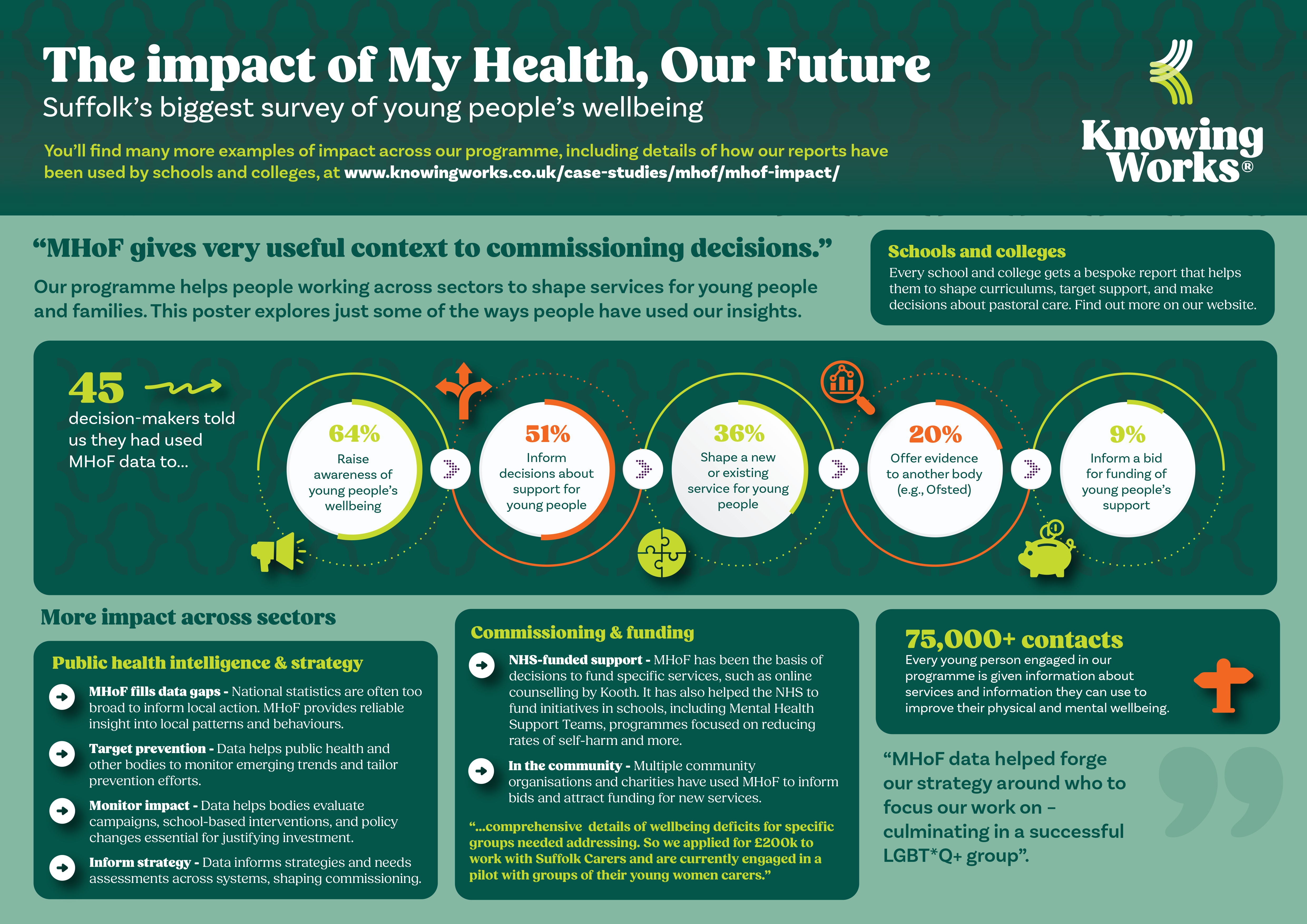
In 2025, we held an online session with more than 45 school, charity, Suffolk County Council and NHS professionals. Here’s how they had used insights from MHoF:
- 64% had educated or raised awareness around young people’s mental health;
- 51% had informed a decision about support for young people;
- 36% had shaped a new or existing service for young people and families;
- 20% provided evidence to another body, such as Ofsted;
- 9% had supported a bid for local funding.
Poster summary
The poster below is a quick summary of some of the information featured on this page. Click the image to download a PDF format.
Examples of impact
Making sure young people can find support they need
Recently, Suffolk County Council told us it monitored MHoF findings to tailor the information it was sharing with young people.
“It helps us put a picture together that shows the feelings and voices of young people in Suffolk, key issues/challenges affecting them. This helps us to shape and update advice to young people on our Source website and our resources, and any areas where more support or information may be needed.”
Every young person participating in our surveys is directed to up-to-date information about sources of information and help if they are worried about their wellbeing – that’s more than 75,000 opportunities to tell young people about support they may need.
This signposting has used both digital and other approaches (such as the sharing of a signposting card in schools and colleges). The card format has also been distributed by other services at times, such as GP practices, school nursing teams and the police.
In 2019, MHoF encouraged and supported a number of local initiatives to tackle self-harm, including new resources created to support young people, families and those working with school-age children and young people under 18 in educational settings. The aim was to raise awareness, help people identify the signs of self-harm and increase knowledge about how to respond to it.
Supporting public health intelligence
Suffolk’s Public Health and Communities Team has told us our data helps to provide consistent evidence it can use to influence how support is offered in Suffolk. Taking our data on rates of vaping and smoking amongst young people as an example, MHoF can:
- Fill critical data gaps: National and regional statistics on youth smoking and vaping are often too broad to inform local action. Primary care data is also limited in this area, particularly for under-18s, making MHoF one of the few reliable sources of insight into local patterns and behaviours.
- Support targeted interventions: Data helps public health and other bodies to monitor emerging trends and identify specific groups or areas where nicotine use is rising. This will enable more timely and tailored prevention and support efforts.
- Demonstrate impact over time: By tracking changes, it is possible to evaluate the effectiveness of local campaigns, school-based interventions, and policy changes. This is essential for demonstrating long-term impact and justifying continued investment.
- Inform strategic planning: Data feeds into broader needs assessments and strategies, including the JSNA ensuring that nicotine use among young people remains a visible and prioritised issue.
Helping local organisations to campaign and support young people
Local organisations have told us that they used MHoF data to secure funding for specific projects that have benefitted young people across the county.
For example, we know from responses to a recent survey about our programme that at least two local leaders had used MHoF data to support successful grant applications. One leader of a local charity said the data had ‘provided supporting evidence for a £1m+ capital funding application’.
Our data had also been used in a grant application by a VCFSE organisation which resulted in the formation of a successful LGBT*Q+ group for young people. Our reports guided the organisation to make decisions about which group of young people to focus their work on.
“We took the headline of low wellbeing amongst young women and LGBT*Q+ young people to help forge strategy around who to focus work with – culminating in a very successful LGBTQ group”.
MhoF data can support our local VCFSE organisations and leaders in other ways too. For example, in 2024, the voluntary Chair of the Haverhill Voluntary and Statutory Partnership (VASP) told us:
“The Haverhill MHoF report was shared with Haverhill VASP and Haverhill Youth Advisory Group (YAG). It promoted discussions around supporting young people to have a toolkit to support other young people who may be experiencing mental health and wellbeing issues”.
Also in 2024, Community Action Suffolk shared our insights with youth workers to inform their practice, facilitated through its ‘Youth Focus Suffolk’ programme of work. Our data was included within the training delivered by a Mental Health Nurse associated with the project to more than 30 youth workers in the county.
“The inclusion of recent data and publications specific to the Suffolk region was very well received and gave delegates the opportunity to fully understand the demographic with which they support and work”.
In 2023, we offered new insights into the extent to which young people may be vulnerable to peer-on-peer sexual harassment at school or college. Fiona Ellis OBE (Co-Founder and CEO of local charity Survivors in Transition) described the importance of this data:
“We have seen the numbers of young people needing support around sexual violence, especially peer on peer harassment increasing year on year. To provide the kind of support young people need, we need to open the conversation and allow young people a safe and supportive platform to talk about what’s happening – and this is a big step in the right direction. We hope these stark findings will inform a different kind of conversation and how we challenge these behaviours in our schools and communities”.
Other examples have included:
- Our report about young people’s mental health and wellbeing in Lowestoft was the basis of a decision by the Lowestoft Community Partnership Board to fund a Sunday afternoon Youth Social Club at Sam’s Café.
- 4YP, a charity providing services to young people, told us our research had been an important source of evidence for successful bids it had made for funding.
- Noise Solution CIC successfully secured £200k to work with young LGBTQ*+ women using our report as evidence to justify local need.
“The report was the impetus for Noise Solution starting a group to work with LGBTQ*+ and young women.
“We felt its comprehensive identification of wellbeing deficits for these groups of young people needed addressing. We applied for funding with Spirit 2012 who gave us £200k to work in partnership with Suffolk Carers and we are currently engaged in a pilot specifically with groups of their young women carers.” – Simon Glenister (Chief Executive, Noise Solution CIC)
Decisions about how money is used
“The MHoF report has given very useful context to commissioning decisions.”
MHoF reports have helped local commissioners and funders to make better decisions about how to spend money available for projects and services for young people in Suffolk.
This has, for example, included decisions to introduce services such as Kooth (online counselling) and to fund initiatives in local schools and colleges. An example of this was the funding of interactive workshops in Suffolk schools and colleges aimed at reducing rates of self-harm reported in our programme.
In past years of the programme, MHoF data helped to establish Whole School Approach initiatives in Suffolk, which in turn were the foundation for successful £2m bids to fund Mental Health Support Teams in schools. They supported the wellbeing of more than 24,000 students in around 64 schools.
Our data initially supported the commissioning decision to fund the pilot of the whole school approaches in Suffolk and we know the lead team used our data to shape support offered to students. This video from 2019 explores the impact of this work.
Shaping strategy
Generally, our findings are discussed annually at every forum established to make decisions about children and young people’s mental health and emotional wellbeing in Suffolk. They have focussed people’s minds on what needs to change and why.
A Suffolk Public Health and Communities Team survey (2024) of local health and care system leaders showed almost half felt MHoF had a significant impact on their work. Two leaders said it had a major impact and five reported a moderate impact.
Year on year, our reports and insights are included in NHS, local authority and public health strategies. To name just a few:
- Suffolk’s Joint Strategic Needs Assessment (JSNA) and, for example, the 2026 re-fresh of Suffolk’s mental health needs assessment – a key assessment by Public Health and Communities to help NHS and other commissioners to understand local need
- Suffolk’s Children’s Health Weight strategy
“…the [MHoF] project has informed the strategy with key information about young people’s mental health and wellbeing. Additional questions were incorporated into the survey to build the voice of young people into the strategy and action plan.”
- A women’s health programme led by the NHS in Suffolk and north east Essex
- Suffolk’s Annual Public Health report (2019)
- NHS commissioning strategies for mental health support locally, such as a ten-year strategy agreed in 2019