In Summary
After the pandemic, many services in the NHS had turned to new digital offers to manage patients remotely and more efficiently. The speed of digital change was significant, which led NHS leaders to seek people’s experiences. It was important to understand how people’s care had been impacted by the scale of digital change and make sure people could still access care they needed.
This research improved understanding of how people were experiencing digital change and supported development of ‘guiding principles’ that have supported NHS and social care services to embrace a digital first, but not digital only, approach to service design.

What people told us
The research
Opinions and experiences were recorded in surveys, online workshops, guided telephone conversations, digital toolkits and as a part of our engagement with local services and Voluntary, Community and Social Enterprise (VCSE) organisations.
People liked having quicker access to health advice and the reduced need for travel, including the associated savings on parking or public transport. Digital services also enabled people to continue to access care safely during the pandemic, something particularly valued by those who had been shielding.
However, the explosion in digital care had not benefitted everybody.
Some experienced poorer physical and mental health outcomes because care had been provided remotely (including misdiagnosis), others had been disadvantaged because services were not accessible (such as for those with specific communication needs), and some felt their relative or friend had lost independence due to a new reliance on others helping them to access services.
Please download our report to learn more about what people told us.
The Guiding Principles
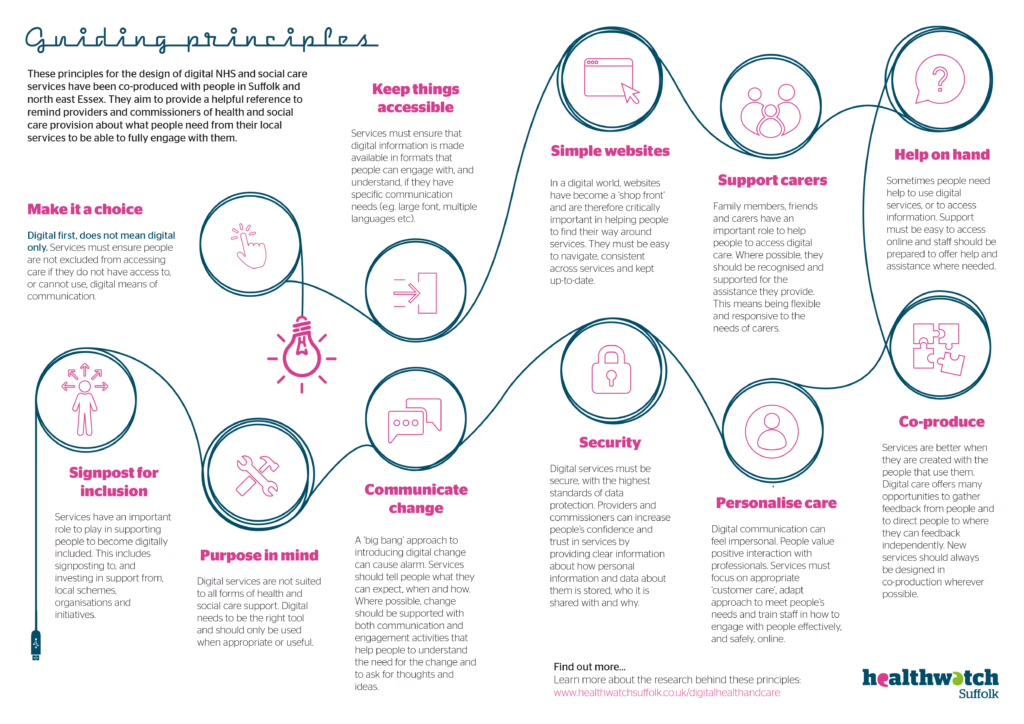
The research helped us to co-produce a set of ‘guiding principles’ for people planning digital care in the NHS and social care. They included (amongst others):
- Commissioners and providers of services should seek to co-produce digital services.
- Digital first does not mean digital only. Services must ensure people are not excluded from accessing care if they do not have access to, or cannot use, digital means of communication.
- Family members, friends and carers have an important role to help people to access digital care. Where possible, they should be recognised and supported for the assistance they provide.
- Digital services are not appropriate for all forms of care. Their use must always be appropriate for the needs of the patient and clinician.
- Commissioners and providers must ensure digital change is communicated in advance and supported by engagement activity.
- Services must be personalised and meet all requirements of the NHS Accessible Information Standard.
- Websites and systems need to be simple, consistent and easy to navigate.
- There is a need to support digital inclusion by signposting to, and investing in, local initiatives.
Please download the principles document to learn more about why they remain relevant to health and care systems now.
The impact of this work
You can learn more about the impact of this work at www.knowingworks.co.uk/case-studies/digitalcare-21/digitalimpact.
Downloads
There are two reports available
- The ‘experience report’ is a summary of everything we heard from people across all phases of the research.
- Our ‘Guiding Principles’ are for anyone involved in planning, designing or running digital health and social care services. They were co-produced with local people and shaped by all the things we heard about people’s experiences, thoughts and wishes for care now and into the future.
Our ‘Guiding Principles’ – Download the summary poster
Our guiding principles are just as relevant now as they were in 2021 and represent key factors that should be considered in the development of any and all digital services providing care.
Click the image below to download our summary poster, or get more detail in the full report.