

In Summary
The wellbeing of more than 13,000 young people in 2023 was revealed in our My Health, Our Future report. Download our reports, and read a summary of key findings, below.
Read a summary of key findings
Did young people’s wellbeing improve in 2023?
Our findings revealed why it’s important for young people to have someone to talk to about their wellbeing at school and college. Those who did were more likely to be happy with school, and to have higher wellbeing overall.
The data also suggested that, for the first time since the height of the COVID pandemic, young people’s average wellbeing began to improve. Furthermore, rates of young people indicating signs of ‘moderate’ to ‘severe’ anxiety slightly reduced this year. However, responses showed that many continued to experience lower levels of wellbeing, and average wellbeing remained below a national average recorded by the NHS in 2020.
We continued to find some groups of young people were much more likely to be vulnerable to lower wellbeing and poorer outcomes across the survey. That included young people who did not identify with binary gender categories, LGBT*Q+ young people, and those who said they had additional support needs (e.g., young family carers, and young people with a disability or mental health diagnosis).
Some key findings from the 2023 survey included:
- About five thousand had seen different forms of potential sexual harassment in school or college.
- Out of a possible wellbeing score of between 7 and 35, the average wellbeing score for young people in Suffolk was 20.3. This is 4.3 points lower than a national NHS average in 2020.
- 37% of young people had ‘moderate’ or ‘severe’ anxiety levels in 2023, compared to 41% in 2022.
- Just 1 in 3 young people feel optimistic about their future.
- Nearly a quarter were either ‘worried’ or ‘very worried’ about the rising cost of living on their lives, and the lives of their families.
- 12% were vaping at the time of the survey, and more than 300 said they were addicted to it.
New insights in 2023
Unwanted sexual behaviours
For the first time, our survey included a definition of sexual harassment as follows:
“Sexual harassment is any unwanted sexual behaviour that makes someone feel upset, scared, offended or humiliated, or is meant to make them feel that way”.
Within this context, young people responded to a series of statements about some forms of harassment they may have seen, ranging from people ‘making sexual jokes’ in school or college, to the sharing of ‘images or videos of other students of a sexual nature’.
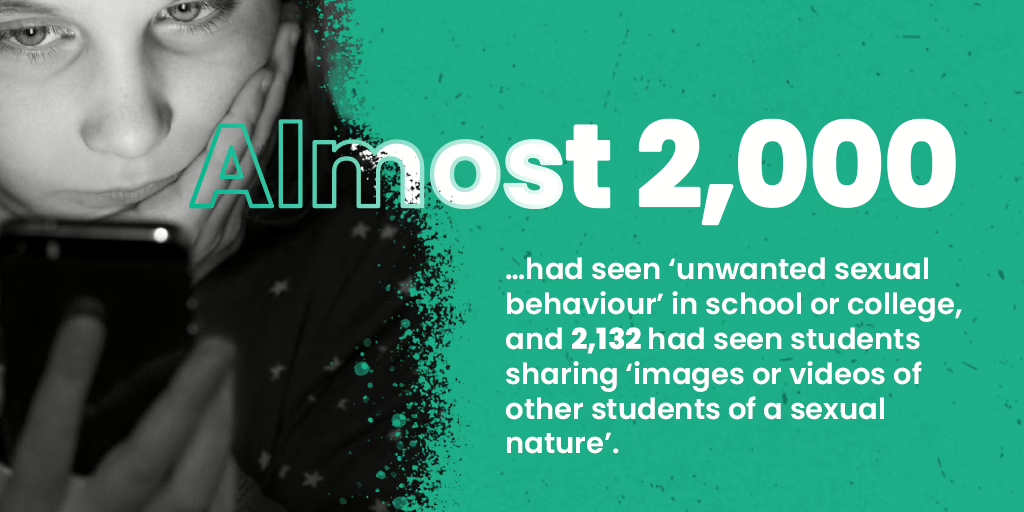
Reflecting national concern from Ofsted, many young people said they had seen at least one form of potential sexual harassment at their school or college. That included 2,132 young people who said they had seen the ‘sharing of images or videos of other students of a sexual nature’, 3,896 who had seen or heard people using homophobic language, and 1,768 who had seen other ‘unwanted sexual behaviour’.
Just a third of respondents said they would feel confident to report sexual harassment, highlighting the need for improved education and awareness around this issue amongst all children and young people. Our findings are reflective of those reported by Ousted, which found incidents of sexual harassment are now so commonplace in schools that young people may see no point in reporting them.
The Good Childhood Index
For the first time, our survey included a new measure known as the Good Childhood Index (GCI) from the Children’s Society.
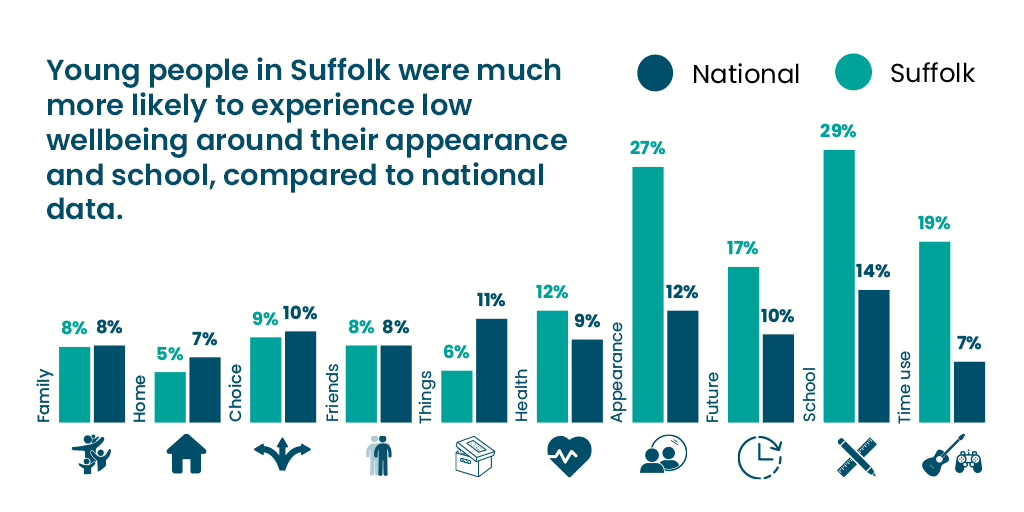
It revealed that young people in Suffolk are much more likely to be unhappy with school, their appearance, and the use of their time, compared to national findings.
When thinking about ‘school’, 17% of students selected scores less than four (from a ten-point scale). These young people were five times more likely to experience ‘low’ wellbeing overall than their peers who indicated they were happy at school.
Understand the impact of MHoF
The NHS commissions the survey in Suffolk to shape and inform decision-making about support for young people across organisations and sectors.
In addition to the countywide survey results, every school or college supporting the survey receives an anonymous report about their students. It helps them to plan, target and construct wellbeing support and strategies.
We share more information about how the programme has made a difference at https://knowingworks.co.uk/case-studies/mhof/mhof-impact.